
What is Legal Design?
Legal design is the practice of intentionally designing how law is experienced, delivered, and sustained by the people who use it and the people who do the work. It applies human-centered design principles to legal systems, services, and organizations, replacing improvisation and tradition with clarity, structure, and purpose.
At its core, legal design asks a simple question:
Does the way law operates actually work for the humans inside it?

Where did Legal Design Come From?
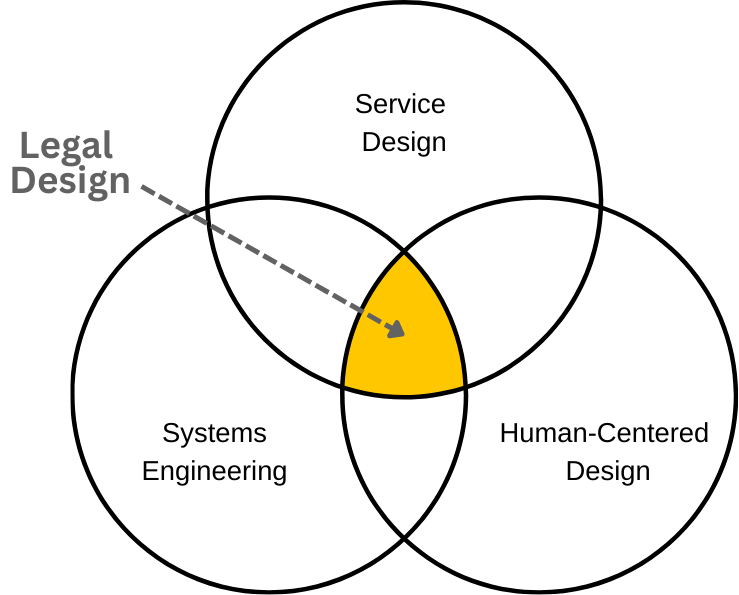
Legal design emerged at the intersection of law, design, and systems thinking.
As legal systems grew more complex, inaccessible, and emotionally taxing, a new generation of lawyers, designers, and technologists began questioning long-standing assumptions about how law had to function. Legal design drew from human-centered design, service design, behavioral science, and systems engineering. The goal was not to simplify the law itself, but to redesign how people interact with it.
How Has Legal Design
Been Applied?
Historically, legal design has focused on improving access to justice and the experience of interacting with legal systems.
This work has included court systems and public institutions, legal information design, forms and documents, visual explanations, and policy innovation. These efforts brought much-needed clarity and dignity to legal experiences that were often confusing, intimidating, or exclusionary. They demonstrated the foundational truth that the way law is delivered matters just as much as the law itself.

Legal Design Inside Law Firms
For a long time, most legal design work stopped at the edges of the justice system while the majority of legal work continued to happen inside private law firms. Firms grew quickly, informally, and under pressure. Processes lived in people’s heads. Technology was layered on without intention. Workarounds became standard operating procedure.
The result was a quiet erosion: burnout, bottlenecks, missed opportunities, and firms that felt more unsustainable year after year. All because the systems supporting law firms and lawyers were never intentionally designed.
Law Firm Architects applies legal design to the operating core of private law firms.
We treat the firm itself as the design challenge. We design how clients enter and move through the firm, how cases flow from intake to resolution, how teams communicate and hand work off, how decisions are made, and how technology supports the work instead of complicating it.
We redesign operating models so people, processes, and systems function as a coherent whole, creating clarity instead of chaos, sustainability instead of burnout, and structure instead of constant improvisation.
Law Firm Architects offers legal design as infrastructure.
Sustainable law firms are not a luxury. They are a prerequisite for accessible, ethical legal services. When firms run on burnout, clients feel the friction, staff carry the cost, and quality suffers quietly. Designing how law firms operate is not separate from justice. It is foundational to it.
Law Firm Architects exists to design law firms that don’t run on burnout.®
Because we believe anything else is unsustainable.